































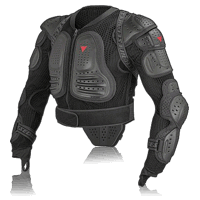
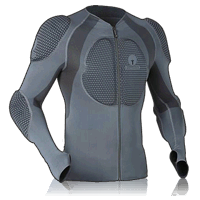
Shoulder protectors
Nothing found for selected filter options. Please choose other options.
Filter & sort
Sortierung
Motorcycle shoulder protectors: Your guide to an essential safety upgrade
Your helmet protects your head, your back protector protects your spine. But what about the area that is almost always one of the first to hit the ground in a sideways fall? Your shoulders. The shoulder joint is the most mobile, but also one of the most complex and vulnerable joints in your body. A hard impact here can quickly lead to painful and protracted injuries to the collarbone, shoulder blade, or the sensitive rotator cuff. A high-quality, certified shoulder protector is therefore not just a “nice-to-have,” but an essential safety upgrade.A high-quality, certified shoulder protector is therefore not a “nice-to-have,” but a fundamental component of your personal protective equipment.
Your motorcycle jacket often has untapped safety potential. Many jackets are only equipped with simple foam inserts or inexpensive Level 1 protectors. Upgrading to a modern, lightweight, and highly effective retrofit protector is perhaps the easiest and most cost-effective way to dramatically increase your safety on the bike. In this guide, we explain everything you need to know about protection levels, materials, and the perfect fit so that you can give your jacket the safety upgrade it deserves.
Why a high-quality shoulder protector is essential
A small, inconspicuous foam pad cannot perform as well as a CE-approved high-tech protector in an emergency. Its job is to protect your complex shoulder joint from the brutal forces of an impact.
The anatomy of risk
Protection for joints, bones, and ligaments When falling onto your side, the entire force of the impact is often directed at the shoulder blade (acromion) and collarbone (clavicle). A good protector acts like a shock absorber:
Energy distribution: It absorbs the point force of the impact and distributes it over its entire surface. This massively reduces the pressure on the bone.
Energy absorption: The material of the protector itself deforms and converts most of the impact energy into heat before it reaches your body. The result: The risk of fractures and joint injuries is significantly reduced.
The upgrade that makes all the difference
Better than the standard The biggest improvement you can make to your safety is to replace the standard protectors. Many motorcycle jackets, even in the premium segment, are often only supplied with simple, flexible Level 1 protectors for reasons of comfort or price. Although these meet the minimum standard, upgrading to a modern Level 2 protector can almost double the impact energy absorbed. This is a safety benefit that you will feel in every fall – or rather, you won't feel it at all.
The path to perfect protection: Your upgrade guide for shoulder protectors
Since shoulder protectors are almost exclusively retrofitted or replacement parts for your jacket, three criteria are particularly important: protection level, technology, and fit in the jacket pocket.
Protection level & EN 1621-1 certification
The most important decision
All protectors for the limbs are tested in accordance with EN 1621-1. Choosing the right protection level is the most important decision you will make.
| Protection level | Residual force (average) | Suitability & properties |
| Level 1 | Less than 35 kN | The solid standard. Offers certified basic protection and is often very thin, flexible, and inconspicuous. Ideal for urban and casual jackets where comfort is paramount. |
| Level 2 | Less than 20 kN | The premium protection class. Absorbs significantly more impact energy and offers a noticeably higher level of safety. The clear recommendation for touring and sports riders and anyone who doesn't want to compromise. |
The technology in the material
Flexibility meets safety
Modern shoulder protectors are no longer stiff plastic shells. The leading technology is intelligent soft foam protectors that offer unmatched comfort.
Intelligent soft foam protectors (D3O®, SAS-TEC®, etc.)
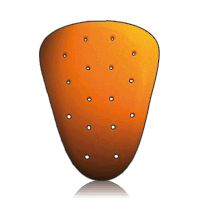
Materials such as D3O® are soft, orange, and flexible in their normal state. They adapt perfectly to the contours of your shoulder and are barely noticeable when worn. However, in the event of a sudden impact, the molecules inside link together at lightning speed, the protector hardens and absorbs the energy. After the impact, it immediately returns to its soft state. The Held Exosafe D3O and the Furygan D3O set rely on this proven technology.
Ventilated and perforated designs
A protector in the jacket can restrict breathability. That's why modern protectors such as the Revit Seeflex RV16 are cleverly designed. Their open, often honeycomb structure allows air to circulate and prevents heat build-up under the jacket without compromising protection.
Compatibility and fit: What you need to look out for!
Shape and size of the protector pocket
This is the most important point when retrofitting! Protector pockets in motorcycle jackets are not standardized. A protector from manufacturer A will not necessarily fit into a jacket from manufacturer B. Our tip: Take your old protector out of your jacket pocket, place it on a piece of paper, and compare its shape and size with the product images and measurements of the new protector.
Brand compatibility
The easiest and safest option is to choose a retrofit protector from the same manufacturer as your jacket. A Revit protector fits perfectly in a Revit jacket, and a Macna protector fits perfectly in a Macna jacket. This guarantees an optimal fit without slipping.
Thickness and comfort
Keep in mind that upgrading from a thin Level 1 protector to a thicker Level 2 protector may affect the fit of your jacket. If your jacket already fits very tightly around the shoulders, it may be a tight fit.
Our top recommendations: The best upgrades for your jacket
From solid replacement parts to high-end Level 2 upgrades – here are our recommendations:
High-end protection: Held Exosafe D3O Shoulder Protectors (Level 2)
If you want maximum safety and comfort, this is the choice for you. The Held Exosafe combines the superior cushioning technology of D3O® with an intelligent, ventilated design and certification to the highest protection level.
The ventilated performer: Revit Seeflex RV16 Shoulder Protectors (Level 2)
The Seeflex from Revit is a technical masterpiece. Its unique open structure offers unmatched ventilation and flexibility while meeting the strict requirements for Level 2 protection. Ideal for touring riders and summer use.
The universal all-rounder: John Doe XTM 3D Protectors (Level 1)
Extremely soft, lightweight, and adaptable. This protector from John Doe is ideal for stylish urban and casual jackets where a thick protector would be uncomfortable. Despite its unobtrusive design, it offers certified Level 1 protection.
The solid replacement: Macna RISC S01 B Shoulder Protectors (Level 1)
Have you lost a protector or is your old one damaged? The Macna RISC is a high-quality, CE-approved standard protector that fits perfectly into all Macna jackets and restores the original level of safety.
FAQ: Frequently asked questions about shoulder protectors
1. Are shoulder protectors mandatory in motorcycle jackets?
In order for a jacket to be sold as certified “motorcycle protective clothing,” it must contain tested shoulder and elbow protectors.
2. How should shoulder protectors fit?
They must completely cover the sensitive shoulder joint (the “corner” of your shoulder) and be centered. They should not slip around loosely in the jacket pocket.
3. Which is better, Level 1 or Level 2?
Level 2 offers a proven higher level of safety through better impact absorption. If possible, upgrading to Level 2 is always recommended.
4. Do protectors from brand X fit in a jacket from brand Y?
Rarely. The shape of the protector pockets is not standardized. It is always safest to combine protectors and jackets from the same manufacturer.
5. Do I have to replace protectors after a fall?
Yes, absolutely. Even if they do not show any visible damage, the microstructure of the material may be impaired, which greatly reduces the protective effect in the event of another impact.
6. Why are modern protectors often soft?
Thanks to intelligent materials such as D3O® or SAS-TEC®. These are flexible and comfortable during normal movements, but harden instantly in the event of an impact, thus offering excellent protection.
7. My jacket doesn't have pockets for protectors. Can I still use them?
No, in this case, retrofitting is not possible. The safer alternative here would be a protective jacket or vest that you wear under your jacket.
8. Are there left and right shoulder protectors?
Yes, shoulder protectors are almost always asymmetrical and ergonomically adapted to the left and right shoulders. Pay attention to the markings when inserting them.
9. How long do shoulder protectors last?
Even without a fall, the materials age. Most manufacturers recommend replacement after about 5 to 7 years to ensure full protection.
10. Does a thicker protector improve the fit of a loose jacket?
Only to a limited extent. A thicker protector fills the pocket better, but if the entire jacket is too loose, the protector will also move with the jacket and will not be in the right place in the event of a fall.
Conclusion: A small upgrade with massive protective effect
Never underestimate the importance of your shoulder protectors. Replacing the often simple standard pads with a high-quality Level 2 model is one of the easiest, cheapest, and most effective ways to significantly increase your safety on a motorcycle. It's a small adjustment that can make a huge difference in an emergency.
Don't settle for the standard. Check your equipment and invest in the best protection available.
Table of contents