














































Battery packs / Charger / Adapte










Filter & sort
Sortierung
Motorcycle batteries and chargers: your ultimate guide to a reliable power supply
It's every motorcyclist's nightmare. The first sunny day of spring, the trip is planned, the gear is ready. You turn the ignition key, press the start button, and... click. Silence. Nothing. The battery is dead. This one moment can make the difference between a perfect day on the bike or hours of frustration in the garage. The motorcycle battery is the heart of your bike's electrical system. It brings the engine to life, powers the electronics, and is the unsung hero of every ride. But precisely because it so often works invisibly, its maintenance is often neglected.
Welcome to the command center for your motorcycle's electrical health. This isn't just about replacing an old battery, but also about understanding how to maximize the life of your power source. What is the difference between an AGM and a lithium battery? Why should you never use a car charger? And how does a modern, intelligent motorcycle charger work? In this ultimate guide, we take you into the world of mobile energy. We explain technologies, unravel the charging and maintenance process, and help you find exactly the products that will keep your motorcycle ready to go.
The lifeline of your motorcycle: the motorcycle battery explained
The battery is much more than just a starter motor. In modern motorcycles with ABS, fuel injection, TFT displays, and countless control units, it is the central power source that keeps everything alive.
The technological battle: lead acid versus lithium-ion – which is the right choice for you?
This is the most important fundamental decision. Both technologies have their advantages.
| Criterion | Classic lead-acid battery (AGM & gel) |
Modern lithium-ion battery (LiFePO4) |
|---|---|---|
| Weight | Heavy. A standard battery often weighs 3-5 kg. | Extremely light. A lithium battery often weighs only 0.5-1 kg. A huge weight saving. |
| Lifespan & cycles |
Good. With proper maintenance, lasts 3-5 years. | Excellent. With proper maintenance, can last 8-10 years and can withstand significantly more charging cycles. |
| Self-discharge | Average. Continually loses charge when not in use (e.g., during winter) and must be recharged regularly. | Extremely low. Can be stored for many months without significant loss of charge. |
| Cold start performance | Good. Proven technology that works reliably even in cold temperatures. | Good, but different. Often requires a short “wake-up pulse” at low temperatures (e.g., briefly turning on the light) to reach operating temperature, but then delivers full power. |
| Price | Cheaper to purchase. | More expensive to purchase, but often cost-effective due to significantly longer service life. |
| Maintenance | More demanding. Must be connected to a trickle charger in winter to prevent harmful deep discharge. | Easy to maintain. Requires less attention due to low self-discharge. |
The most important tool: the intelligent motorcycle charger
A special motorcycle charger is the best investment you can make for a long battery life. It is much more than just a “power supply”.
Why you should NEVER use a car charger
A typical car charger operates with a charging current (amps) that is much too high. This would cause a small motorcycle battery to “overheat” and break down in no time. A motorcycle charger operates at a very low, gentle charging current (usually 0.8 - 1.0 A), which is perfectly matched to the low capacity of motorcycle batteries.
The 8 levels of intelligence: what a modern charger can do
A high-tech charger like this is a battery doctor. It goes through a fully automatic, multi-stage process:
- Diagnosis: it checks whether the battery can hold a charge at all.
- Desulfation: it removes harmful sulfate crystals from the lead plates of deeply discharged batteries.
- Main charge: gently charges the battery to approximately 80%.
- Absorption charge: fully charges the battery to 100% with decreasing current.
- Analysis: it checks again whether the battery is holding the charge.
- Reconditioning (RECOND): a special mode to revive deeply discharged batteries.
- Float charging: It keeps the voltage at the maximum level.
- Pulse maintenance charging: It gives the battery small charging pulses for months, keeping it in perfect condition without overcharging it.
Specialists for every technology: lithium versus lead acid
Lithium batteries require a completely different charging algorithm than lead-acid batteries. Using the wrong charger can instantly destroy an expensive lithium battery!
The champion for lead acid: Tecmate OptiMate Lithium 4S
This is the award-winning all-rounder for all types of lead-acid batteries (wet, AGM, gel).
The flexible DUO charger: Tecmate OptiMate 2 Duo
A duo charger is ideal for workshops or motorcyclists with multiple vehicles. It automatically recognizes whether a lead-acid or lithium battery is connected and selects the appropriate charging program.
FAQ: Frequently asked questions about motorcycle batteries and chargers
1. Which battery is best for my motorcycle?
That depends on your priorities. If you are looking for maximum weight savings and a long service life, a lithium battery is the best choice. If you value proven technology and a more affordable price, a high-quality AGM or gel battery is an excellent option.
2. Can I use a car charger for my motorcycle?
No, absolutely not! The charging current is much too high and would destroy the small motorcycle battery. Always use a special motorcycle battery charger with a charging current of approximately 1 amp.
3. How do I charge my motorcycle battery correctly?
First connect the red cable (+) to the positive terminal and then the black cable (-) to the negative terminal. Select the correct mode on the charger (e.g., “motorcycle”) and start the charging process. An intelligent charger does the rest automatically.
4. Do I have to remove the battery to charge it?
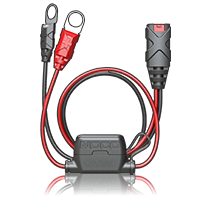
No. With a modern, spark-free charger, you can charge the battery directly in the motorcycle. Many motorcyclists install a fixed charging connection in an easily accessible place on the motorcycle.
5. How long does a motorcycle battery last?
With proper maintenance, a lead-acid battery will last approximately 3-5 years. A lithium battery can have a lifespan of 8-10 years. However, poor maintenance (deep discharge in winter) can destroy a battery in a single season.
6. What is the difference between an AGM and a gel battery?
Both are maintenance-free lead-acid batteries. In an AGM (Absorbent Glass Mat) battery, the acid is bound in a glass fiber mat. This battery is shock-resistant and delivers high starting currents. In a gel battery, the acid is bound in a gel. This battery is even more cycle-resistant and less sensitive to deep discharge.
7. What should I look out for with a lithium battery?
This battery is extremely light and durable, but requires a special lithium charger. At low temperatures below 5 °C, it often needs a short “wake-up call” (e.g., briefly turning on the ignition) to deliver its full power.
8. What does “charge retention” mean?
This is the most important function for winter storage. The charger remains permanently connected to the battery. It monitors the voltage and only delivers small charging pulses when necessary. This prevents self-discharge and keeps the battery in perfect condition.
9. Can I use a battery charger to revive a completely flat battery?
High-quality chargers such as the CTEK MXS 5.0 have special reconditioning modes that can often revive a deeply discharged (but not defective) battery.
10. What is a “booster”?
A booster (or jump starter) is essentially a large battery that can deliver a very high current for a short time to start a vehicle with a dead battery without the need for a second vehicle. The CTEK CS Free has this function integrated.
Conclusion: the source of your freedom
The battery and its charger are the unsung heroes of your equipment. They work quietly, but their performance determines the success of every trip. Investing in a high-quality battery and an intelligent charger is not an expense, but the smartest insurance against the frustration of breakdowns and for a long, reliable motorcycle life.
Ensure the correct voltage.
Table of contents