
































Crash Guards










Filter & sort
Sortierung
Motorcycle crash bars: Your ultimate guide to the best insurance for your bike
A brief moment of inattention while maneuvering, slippery ground when parking at a scenic spot, an unfortunate slip in a curve— there are countless scenarios that can quickly end in disaster. A motorcycle that falls over or crashes can cause thousands of dollars in damage: a scratched engine cover, a broken fairing, a dented tank. But there is a simple and extremely effective piece of equipment that can protect your motorcycle from precisely these expensive and annoying consequences: a high-quality motorcycle crash bar.
A crash bar is much more than just a visual accessory. It is an intelligently designed crumple zone, a sturdy cage that protects the most vulnerable and expensive parts of your motorcycle in the event of an accident. It is perhaps the smartest and most valuable investment you can make to maintain the value of your machine. In this ultimate guide,we take you deep into the world of crash bars. We explain the crucial differences between engine and fairing protection, show you why a model-specific design is essential, and help you find the perfect armor for your bike with detailed purchasing advice.
The mission of crash bars: More than just protection against falls
Professional crash bars are multifunctional components whose advantages go far beyond mere fall protection.
1. Primary protection: engine, tank, and fairing
This is its core function. A crash bar made of sturdy, powder-coated steel tubing is attached to the most stable points of the motorcycle frame. In the event of a fall or crash, it is the first point of contact with the ground. It absorbs all the impact energy and distributes it to the frame.
Your advantage: Sensitive components such as the side engine covers (which contain magnesium in many models and break easily), the tank, or expensive plastic fairing parts do not come into contact with the ground in the first place. A repair that could otherwise quickly run into four figures is reduced to a scratched bar, which can often be easily replaced.
2. Protection for the rider: added safety
Even if it is not its main purpose, a crash bar can also protect the rider. In the event of a slip, it can prevent the rider's leg from being trapped and crushed under the weight of the motorcycle.
3. The practical basis: Attachment points for accessories
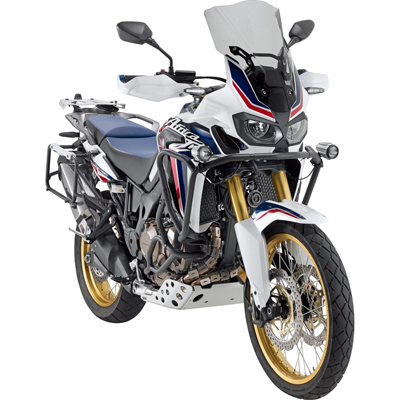
Particularly in the adventure and touring sectors, the protective bar becomes a practical mounting platform. Many riders use the sturdy tubes to attach useful accessories, such as:
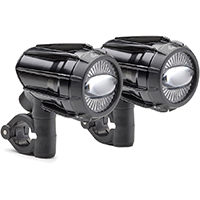
Additional headlights for better visibility at night.
Action cam mounts for spectacular perspectives.
Small additional bags for tools or a water bottle.
The different systems: Find the perfect armor for your bike
Not all protective bars are the same. The design depends heavily on the type of motorcycle and the area to be protected.
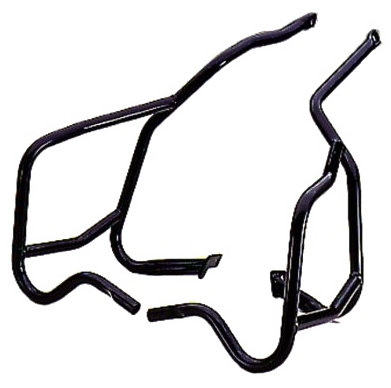
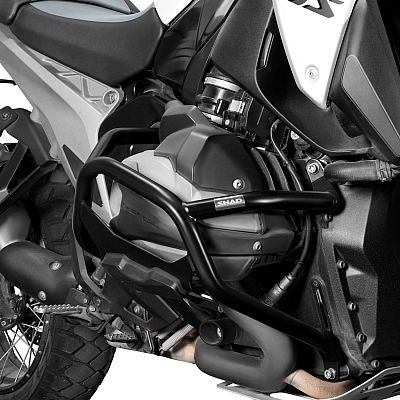
The classic engine guard: The foundation of protection
Description: This is the most basic and widely used type. The bar focuses on protecting the engine and the lower, front parts of the frame. It is the first choice for naked bikes, retro bikes, and many tourers.
Product example: Givi TN crash bars
The Givi TN crash bar is a prime example of such a classic, robust, and model-specific engine guard that combines effective protection with a discreet look.
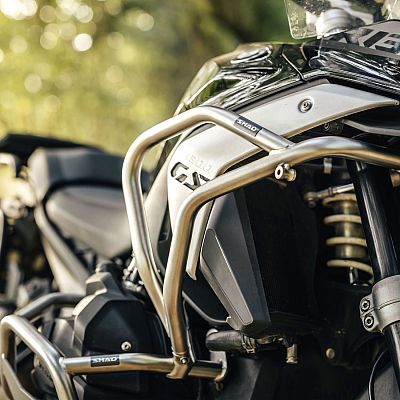
The upper protective bar (fairing protection): The extension for tanks & co.
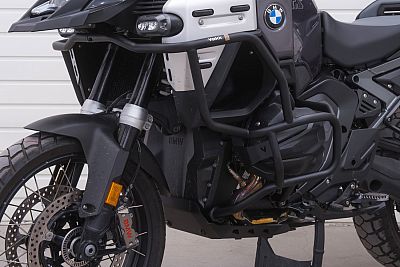
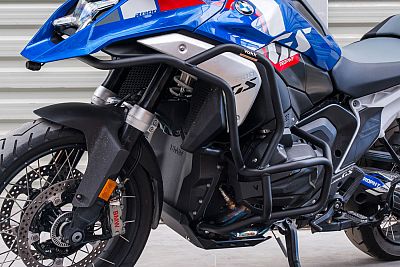
Description: Especially for large touring enduros with protruding tanks and high fairings, a simple engine guard is not enough. An upper protective bar is additionally mounted (often attached directly to the lower bar) and extends upwards to protect the tank and upper fairing parts.
Product examples: SW-Motech SBL crash bars
The SW-Motech SBL crash bar above is one such extension that is perfectly matched to the lower bars from the same manufacturer.
Buying advice & legal information: How to find the right crash bar
The golden rule: model-specific fit is everything!
A crash bar is not a universal part. It is a high-precision component that is tailored precisely to the frame geometry and mounting points of your motorcycle model and year of manufacture. Designers invest a lot of time to find the perfect mounting points that can safely transfer the impact energy into the frame without overloading weak points such as engine housing bolts. Therefore, always use the vehicle-specific filter in our shop to guarantee you find the right bar for your bike.
The material: steel vs. stainless steel
Steel (powder-coated): The absolute standard. Extremely robust, tough, and can deform on impact to absorb energy without breaking immediately. The high-quality powder coating provides reliable protection against rust.
Stainless steel: The main advantage is its corrosion resistance. Even deep scratches in the material do not lead to rust. Stainless steel is often slightly more expensive and can be more brittle than normal steel.
Legality: Do crash bars require registration?
Generally, no. In Germany, crash bars are not considered components that require registration. They do not require ABE approval and do not need to be inspected by the TÜV, as long as they are installed correctly and do not impair the function of other components or pose a hazard (e.g., due to sharp edges).
FAQ: Frequently asked questions about motorcycle crash bars
1. Are crash bars really worth it?
Yes, absolutely. It is one of the best forms of insurance against extremely expensive damage in the event of a simple fall or a slight skid. The cost of the bar is often only a fraction of what a new engine cover or fairing would cost.
2. Does a crash bar affect the lean angle?
A well-designed, model-specific crash bar does not affect the maximum lean angle in normal road use. It is designed so that other parts, such as the footrests, touch the ground first.
3. Do I have to drill or weld to the frame for installation?
No, absolutely not! Each model-specific crash bar is attached exclusively to the existing screw points on the frame provided by the vehicle manufacturer.
4. How difficult is installation?
With good tools (especially a torque wrench) and a basic understanding of technology, most hobby mechanics can do the installation themselves. Detailed installation instructions are always included. If in doubt, however, the installation should always be carried out by a specialist workshop.
5. Can I install an upper fairing protection bar without the lower engine protection bar?
No. The upper bar is usually attached to and supported by the lower bar. It needs the lower bar as a stable foundation.
6. What is the difference between a crash bar and crash pads?
Crash pads are small plastic or metal pucks that offer localized protection. They are discreet, but in the event of a slip, they can direct all the force to a single point on the frame. A crash bar distributes the impact energy over a much largerarea and multiple attachment points, which is gentler on the frame and offers more extensive protection.
7. Can I lift my motorcycle by the crash bar?
No, it is not designed for this purpose. It is built to absorb impact and pressure forces, not tensile forces.
8. My crash bar is bent after a fall. Can I continue to use it?
This is not recommended. Even if there are no visible cracks, the material structure may be weakened. In addition, the fit is no longer 100% correct, which can lead to uncontrolled force transmission in the event of another fall.
9. What should I do if the powder coating on my steel crash bar is scratched?
You should repair the area as soon as possible with a suitable touch-up pen to prevent rusting.
10. Are there also protective bars for the rear of the motorcycle?
Yes. These are often referred to as “rear protection bars” or “luggage protection bars” and are particularly popular in the adventure sector. They protect the luggage, exhaust, and rear of the motorcycle in the event of a fall.
Conclusion: Priceless peace of mind
A protective bar is the silent, strong guard at the side of your motorcycle. You won't notice it on most rides, but at the crucial moment you will be infinitely grateful that it is there. Not only does it protect the value of your machine, it also gives you mental freedom and the reassuring feeling of being well prepared for the minor mishaps of biker life.
Give your bike the armor it deserves.
Table of contents