
















































Drive


Filter & sort
Sortierung
Motorcycle Drive: Your Ultimate Guide to Chain, Maintenance, and Performance
The engine roars, the gears shift—but how does this explosive power actually get to the road? The answer lies in the secondary drive, the crucial system that transfers power from the transmission to your rear wheel. And in the world of performance motorcycles, there has been one undisputed champion for decades: the chain drive. It is light, extremely efficient, and offers an unmatched direct connection between your throttle and the asphalt. But this direct connection to power requires knowledge, attention, and proper maintenance.
Welcome to the command center for your motorcycle's drive system. Here you will find everything you need for durable and powerful power transmission. From a complete chain set as the heart of your drive system to an intelligent, automatic chain cooler that takes the tedious work of lubrication off your hands. In this ultimate guide, we take you through the technology of the drive chain. We explain the difference between O, X, and Z rings, show you how a new transmission can change the character of your motorcycle, and introduce you to the smartest maintenance systems.
The chain drive: the heart of performance
While cardan shafts and belts are designed for comfort and low maintenance, the chain is the first choice for anyone who values maximum performance and minimum weight.
Why the chain dominates: efficiency & lightness
Highest efficiency: a clean, well-lubricated chain drive has the least power loss of all drives. Almost the entire power of the motor is transferred to the rear wheel.
Low unsprung masses: the sprocket and chain itself are relatively light. This reduces the unsprung masses on the rear wheel, resulting in a more responsive suspension and better contact with the road surface.
Adaptability: no other system allows you to change the gear ratio so easily and thus adapt the characteristics of your motorcycle.
The anatomy of the chain: A perfectly matched trio
A chain set always consists of three components that wear out as a unit and therefore always have to be replaced together.
The chain: high-tech in every link
Modern motorcycle chains are not simple bicycle chains. The crucial technology is hidden between the links: sealing rings in the form of O-, X-, or Z-rings enclose a special grease filling in the chain hinges. This ensures permanent internal lubrication, reduces wear, and significantly extends service life.
The sprocket: the little powerhouse
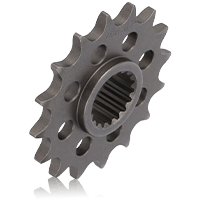
The small sprocket at the output of the gearbox. It is exposed to extreme forces and is therefore made of high-quality, hardened steel.
The sprocket: the big powerhouse at the rear
The large gear wheel on the rear wheel. There are two material philosophies here: steel for maximum durability (ideal for touring riders) or aluminum for minimum weight (ideal for the race track).
Standard vs. tuning: choose your chain set
The reliable all-rounder: A standard chain set offers the original gear ratio specified by the manufacturer and a steel sprocket. It is the perfect, durable choice for everyday use and touring.
Product example: The Afam standard steel chain set is a high-quality replacement solution in OEM quality.
The lightweight performer: with a tuning chain set, you can optimize the performance of your bike.
Product example: Supersprox Performance Kit
The Supersprox Performance Kit takes this a step further with its Stealth sprocket, combining a lightweight aluminum core with a durable steel sprocket ring—the best of both worlds.
The revolution in chain maintenance: automatic chain lubrication systems
The biggest disadvantage of chain drives is that they require maintenance. Regular cleaning and lubrication are a must. Or you can simply leave this work to an intelligent system.
Why manual lubrication is often not optimal
Lubricating with chain spray every few hundred kilometers is the norm. But often people lubricate too much (which leads to dirt and grease being thrown off) or too little (which increases wear). Automatic chain lubrication is the better solution here. It continuously supplies the chain with a minimal but sufficient amount of oil while riding.
How it works: Permanently lubricated
A small oil reservoir is mounted on the frame and a thin hose is connected to the nozzle near the sprocket. The system dispenses oil drop by drop onto the chain while riding. Centrifugal force distributes the oil evenly, lubricating the chain and simultaneously throwing off dirt. The chain cleans itself, as it were, and always runs in a fresh film of oil. The result: the service life of a chain set can be three to seven times longer!
FAQ: Frequently asked questions about motorcycle drives
1. Which is better: chain, cardan shaft or belt?
Chain: best performance, light, high efficiency, but maintenance-intensive. Cardan shaft: extremely low maintenance, durable and clean, but heavy and expensive. Belt: very quiet, clean and low maintenance, but not as robust as a chain or cardan shaft.
2. How often should I lubricate my motorcycle chain?
For manual maintenance, it is recommended to lubricate every 500-1000 kilometers, as well as after every ride in the rain. With automatic chain lubrication, you only need to refill the oil reservoir every few thousand kilometers.
3. When is a chain set worn out?
A clear sign is “shark teeth”: the teeth of the sprocket become pointed and hook-shaped. Another sign is when the chain can be lifted at the rear end of the sprocket.
4. What do 520, 525, 530 mean on a chain?
This is the chain pitch. The first digit (5) indicates the distance between the rivets (5/8 inch). The last two digits (20, 25, 30) indicate the inner width of the chain. A 520 chain is narrower and lighter than a 530 chain.
5. Can I switch to a different chain pitch (conversion)?
Yes, this is a popular tuning option in racing. Converting from a 525 to a lighter 520 chain reduces the rotating masses. Important: you will need to purchase the complete chain set (chain, sprocket, chainring) in the new pitch.
6. What is the difference between O-, X-, and Z-ring chains?
These are the shapes of the sealing rings. O-rings are the standard. Due to their X-shape, X-rings have two sealing lips on each side, which reduces friction and improves sealing. Z-rings are a further optimization of this principle.
7. How do I change the gear ratio of my motorcycle?
By replacing the sprocket and/or chain wheel.
Smaller sprocket (front) or larger chain wheel (rear): Shorter gear ratio -> Better acceleration, lower top speed.
Larger sprocket or smaller chainring: Longer gear ratio -> Lower revs at cruising speed, higher top speed.
8. Do I need to clean the chain before lubricating it?
Yes. If you lubricate a dirty chain, the dirt will bind together and form an abrasive paste that accelerates wear. First clean the chain with a special chain cleaner.
9. How do I tension my motorcycle chain correctly?
The chain needs a certain amount of slack (sag), which is specified in your motorcycle's manual (usually 2-4 cm). A chain that is too tight will destroy the bearings in the gearbox and wheel.
10. Is an automatic chain cooler worth it?
For anyone who rides a lot, goes on tours, or commutes: yes, absolutely. The investment pays off thanks to the significantly longer service life of the chain set and the enormous comfort it provides.
Conclusion: the lifeline of your performance
Your chain drive is a technical marvel that gives you a direct and low-loss connection to the road. But this performance needs to be maintained. A high-quality chain combined with proper, regular lubrication is the key to thousands of kilometers of riding pleasure, reliability, and safety. Whether you opt for tried-and-tested manual maintenance or leave this task to an intelligent, automatic system, give your drivetrain the attention it deserves.
Optimize your power transmission.
Table of contents