





























Socks



















































Filter & sort
Sortierung
Functional motorcycle socks: your guide to perfect feet in every situation
You've invested in top-quality, waterproof, protective motorcycle boots. You're ready for the big trip, the hot summer day, or the cool autumn ride. But have you ever thought about what happens inside those boots? Choosing the right socks is one of the most underestimated, yet crucial details for your comfort on the bike. The wrong socks can turn a dream trip into a nightmare of pressure points, sweat, and cold feet.
A high-quality functional sock is much more than just a sock. It is a high-tech textile specially developed to regulate the climate in the demanding environment of a thick motorcycle boot. They are your first line of defense against blisters, pressure points, and extreme temperatures. In this ultimate guide, we take you into the world of functional socks. We explain why a simple cotton sock is not suitable for motorcycling, which materials and technologies make the difference, and how you can find the perfect sock for every season and every riding style.
Why special functional socks? The decisive difference
Many cyclists think that all socks are the same. That is an expensive misconception, which can affect comfort and even safety.
The moisture dilemma: cotton is your enemy
Your feet have thousands of sweat glands. Thick, poorly ventilated motorcycle boots quickly create a humid environment. A normal cotton sock absorbs this sweat like a sponge and stays wet.
The consequences:
In summer: Wet skin becomes soft, extremely sensitive to friction, and prone to painful blisters.
In winter: The stored moisture cools down extremely quickly in the cold environment. Wet feet are cold feet – guaranteed.
The superpower: active climate control
This is the decisive advantage of functional socks. Special synthetic fibers (such as polypropylene, polyamide) or natural fibers such as merino wool do not retain moisture. They absorb sweat directly from your skin and, thanks to their fiber structure, quickly wick it away from your foot. The foot remains significantly drier and the climate inside the boot remains stable. The result is greater comfort, no blisters, and significantly warmer feet in winter.
Cushioning & protection: targeted pressure relief
Motorcycle boots are hard and inflexible. They cause pressure points on the shin, ankle, heel, and toes. Functional socks feature anatomically shaped padding and reinforcement in precisely these areas. These distribute pressure, prevent chafing, and significantly increase comfort during long rides.
The right sock for every season: your material guide
The choice of your sock depends 100% on the temperature and the purpose for which you will be using it.
For summer: focus on cooling and dryness
Mission & material: on hot days, perfect moisture management is crucial.
Thin summer socks are designed to wick sweat away from the skin as quickly as possible, keeping the skin dry and cool. They are usually made from a light, water-repellent synthetic blend.
Product example: Dainese Dry Mid socks
They are a textbook example of a technical summer sock. Their special “Dryarn” fabric is extremely breathable and optimized to keep the foot dry even in extreme heat.
For the transition period & long trips: all-round comfort
Mission & material: balance is needed here
A balance is needed here between moisture management, light insulation, and good cushioning. These all-rounders are the perfect choice for most conditions in spring and fall. They often consist of a blend of synthetic fibers and some merino wool.
Product example: Revit Javelin 2 socks
They are an excellent all-rounder. They offer an anatomical fit with padding in the crucial areas and a material that ensures a balanced climate in the boot.
For winter: the battle against the cold
Mission & equipment: in winter, the mission is clear: insulation.
Winter socks are significantly thicker and contain a high percentage of insulating fibers. Merino wool is often the first choice here, as it retains heat excellently even when slightly damp.
Product example: Dainese Thermo Mid socks
They have been specially developed for riding in cold temperatures. The material mix is designed to retain maximum body heat and protect the feet from cooling down, even during long winter rides.
Special socks for special requirements
In addition to seasonal socks, there are also socks that have been developed for very special requirements.
For the track: maximum feel and fit
Description: In a tight-fitting racing boot, every bit of feel counts. That's why racing socks are designed to be extremely thin, high, and seamless. They offer light compression to support the muscles and ensure that the sock is absolutely wrinkle-free and does not cause any pressure points.
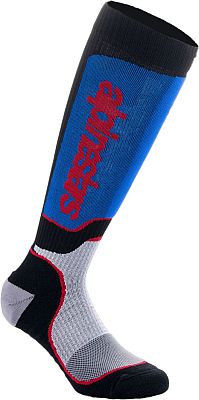
Product example: Alpinestars Racing Road socks
They are specially designed for this purpose. They are thin, wick away moisture, and provide a perfect fit in sports shoes.
For long distances: The power of compression
Description: Prolonged sitting on a motorcycle can impede blood circulation in the legs and lead to tired, swollen feet. Compression stockings exert light, gradual pressure on the legs. This supports the venous return of blood to the heart, improves oxygen supply to the muscles, and can thus actively counteract fatigue.
Product example: Lenz Running 3.0 socks
Although they originate from running, their compression technology and anatomical fit offer exactly the benefits that long-distance motorcyclists appreciate.
FAQ: Frequently asked questions about functional motorcycle socks
1. Why shouldn't I wear regular cotton socks?
Cotton absorbs sweat and stays wet. In summer, this leads to blisters, and in winter, to freezing cold feet due to evaporative cooling.
2. What is the advantage of merino wool in socks?
Merino wool is a natural fiber that provides excellent insulation (even when wet), regulates temperature, and is naturally antibacterial, preventing odor.
3. My feet sweat a lot. Which socks are best?
Choose thin socks made of pure synthetic fibers (e.g., with polypropylene or “Dryarn”). These are designed for maximum and rapid moisture wicking.
4. How high should motorcycle socks be?
The sock should always be higher than the shaft of your boot. This prevents the hard edge of the boot from rubbing directly against your skin. Knee socks are therefore ideal for high touring or racing boots.
5. Do compression socks really help during long trips?
Yes. Many long-distance riders report noticeably less tired and swollen legs and feet at the end of a long day of riding.
6. Are waterproof socks a good idea?
Waterproof socks (with their own membrane) are a good emergency solution if your boots are not waterproof. However, keep in mind that they are less breathable than normal functional socks. If the boot fills with water, your foot will still be standing in water.
7. How do I wash my functional socks properly?
On a delicate cycle at 30°C or 40°C. Turn them inside out and use a functional detergent. Never use fabric softener!
8. Can I wear two pairs of socks on top of each other when it's cold?
This is not recommended. It often impedes blood circulation and, paradoxically, leads to even colder feet. A single, good thermal sock is always the better choice.
9. What does “anatomically shaped” (L/R fit) mean?
This means that there is a specific left and right sock. These are based on the asymmetrical shape of the feet and offer a better, wrinkle-free fit.
10. How do I find the right size?
Start with your normal shoe size. Functional socks are elastic and usually cover a range of sizes (e.g., 42-44). If you are exactly between two sizes, choose the smaller size to ensure a wrinkle-free fit.
Conclusion: the basis for your riding comfort
It may seem like a small detail, but the right sock is the basis for your overall riding comfort. It is the direct point of contact between you and your boot. Investing in a pair of high-quality socks for different seasons is one of the simplest and most effective ways to increase your comfort on the motorcycle. No more pressure points, blisters, and cold feet!
Give your feet the high-tech treatment they deserve.
Table of contents